Introduction
Great entrepreneurs don't start with a solution. They start with a problem worth solving. Opportunity Hunters teaches you to find those problems and read them as opportunities.
Over one semester, you learn from founders, managers, and executives who share how they actually built their companies — the real path, not the textbook version. Then you put that mindset to work: you choose a real-world problem space, map it first with AI, and explore it yourself through interviews, observations, and field days. You leave able to tell a promising opportunity from a dead end, and to back your judgment with evidence.
About the program
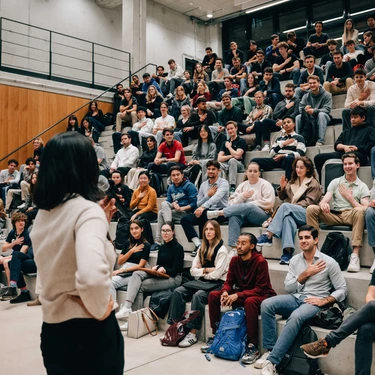
At the heart of the course are people who have built real companies. In eight speaker sessions, outstanding founders and industry leaders share their career paths and founding stories: how an idea became a company, the hurdles along the way, and what shaped them. They come from a wide range of industries — role models to learn from, not case studies. After a session, you can pick up an unsolved problem the speaker sees in their field and make it the focus of your own project.
And the evening doesn’t end when the talk does. Over food and drinks, you can carry on the conversation with the speakers and your fellow students — a relaxed setting to ask the questions that matter and to start building your own network.
Alongside the sessions, a kick-off and a methods masterclass give you the tools to work like a field researcher: how to run interviews, observe in the field, and turn what you find into insight.
Then you go hunting.
How the project works
- Explore with AI first. You use AI tools to map your chosen problem space — sub-problems, stakeholders, existing solutions, and trends. This is your starting point, captured in full (including your prompts) before any fieldwork begins.
- Prove it in the real world. Then, without AI, you explore the same problem space through primary research: interviews, observations, and a field day. You validate and quantify the sub-problems — how many people are affected, where the problem occurs, what it costs and for whom, and how often it happens. You check whether the problems are systemic and how they connect, and you use trend analysis to filter the signal from the noise.
- Compare AI to reality. You reflect on where the AI was right, what it missed entirely, and where it drifted from the real data — building the judgment to use AI well and question it hard.
- Learn from your peers. You review five fellow students' problem analyses against a shared rubric and give constructive feedback — and receive it on your own work.
The best work is presented at a closing showcase.
Experience a kick-off of Opportunity Hunters with us!
Choose Your Version: Opportunity Hunters or Opportunity Hunters Pro
Opportunity Hunters runs in two versions that share the same structure and the same speaker sessions. Which one you take depends on your study level.
Opportunity Hunters — Bachelor
- A strong focus on opportunity recognition: your Problem Space Document includes an explicit opportunity assessment — why this problem is an entrepreneurial opportunity, and which founding-story insights shaped your view.
- At least three primary interviews or field observations.
- A methods masterclass covering the essentials of qualitative research.
Opportunity Hunters Pro — Master
- A research-grade problem study: at least eight primary interviews, planned and analysed independently.
- An advanced methods masterclass: theoretical sampling, coding procedures, reflexivity, and triangulation.
- A curated reading list, with at least three texts referenced in your Problem Space Document.
- New: now open to Management and Technology Master students, alongside the many other TUM programs where it already counts.
Both versions are worth 6 ECTS, are taught in English, and are assessed individually.
Learning Goals
By the end of the course, you can:
- read a problem space like an entrepreneur and spot the opportunity inside it
- break a broad problem into concrete, addressable sub-problems
- validate and quantify a problem with real evidence — who is affected, where, at what cost, and how often
- see whether problems are systemic and how they connect
- run trend analysis to find the signals that matter
- apply qualitative research methods: interviews, field observations, and field days
- use AI to explore a problem space, and judge its output critically against reality
- reflect on your own assumptions and how your perspective changed in the field
communicate your findings clearly and convincingly
Schedule
Sessions take place on Thursdays, 17:30–19:00, mostly hybrid: join on-site at TUM Campus Munich or Garching Forschungszentrum, or online, for full flexibility. After the speaker sessions, you complete your own six-week fieldwork on a rolling schedule, followed by the closing showcase and the peer review during the examination period.
The full speaker line-up for Winter Semester 2026/27 will be published here soon.
October
22.10.2026 Thursday | Kick-off (as part of Climate Week), Problem Space 1:
Helmut Schönenberger, CEO UnternehmerTUM & Vice President TUM Gyri Reiersen, Co-Founder & CPO, Tanso |
|---|---|
29.10.2026 Thursday
Hybrid | Methods Masterclass |
November
05.11.2026 Thursday
Hybrid | Problem Space 2:
Philipp Engelhardt, Director Entrepreneurship & Tech Education, UnternehmerTUM |
|---|---|
12.11.2026 Thursday 17:30-19:00
Hybrid | Problem Space 3:
Hubert Altschäffl, Executive Board Member for Human Resources (CHRO), MAN Truck & Bus SE Expert TBA, MAN SE |
19.11.2026 Thursday 17:30-19:00
Hybrid | Problem Space 4:
Felix Poernbacher, Co-CEO & Co-Founder, DeepDrive |
26.11.2026 Thursday 17:30-19:00
Hybrid | Problem Space 5:
Jean-Pascal Lutze, CEO & Co-Founder, NoMaze |
December
03.12.2026 Thursday
Hybrid | Problem Space 6:
Stephan Herrmann, Co-Founder & Chief Executive Officer, Reverion |
|---|---|
10.12.2026 Thursday
Hybrid | Problem Space 7:
Gloria Seibert, Entrepreneur, Investor & Board Member (Founder of Temedica) |
17.12.2026 Thursday
Hybrid | Problem Space 8:
Flora Geske, CEO & Co-Founder, summ.ai |
January
07.01 - 28.01, 2027 — Fieldwork, submissions & peer review
February
04.02.2027 (17:30 - 19:00) — Final Event (onsite)
Registration
Opportunity Hunters is open to everyone, and TUM students and researchers can earn ECTS credits. No prior knowledge of entrepreneurship is needed — bring an open mind and curiosity about real problems. Fluent English is required, since all sessions and assessments are in English. To earn credits, register for the exam on TUMonline.
Guest listeners are welcome. [To register as a guest listener, please send us an email to opportunity-hunters@unternehmertum.de]
FAQs
-
Do I need a background in entrepreneurship?
No. The course is open to all disciplines and study levels. An open mind and curiosity about real-world problems are all you need to start.
-
Do I need my own startup idea?
No. You choose a real-world problem space — often one raised by a speaker — and explore whether it holds an entrepreneurial opportunity. The whole point is to find the problem before the solution.
-
Is this group work?
No. The project is completed individually, so every participant develops their own judgment and research skills. You do, however, exchange structured feedback with peers.
-
Can I take part online?
Sessions are mostly hybrid, so you can join on-site in Munich or online. You plan and run your own fieldwork within the given timeframe.
-
Is there time to network?
Yes. After each session, food and drinks are on us, so you can meet the speakers and your fellow students in a relaxed setting. This informal exchange is a real part of the course — and a good chance to build new connections.
-
How is the course graded?
There is no written exam. Your grade is based on four parts: AI analysis and critique (5%), the Problem Space Document (50%), a reflection on AI versus primary research (25%), and the peer review (20%).
-
How many interviews do I need?
Bachelor students conduct at least three primary interviews or field observations. Master students (Pro) conduct at least eight and reference at least three texts from the reading list.
-
What's the difference between Opportunity Hunters and Opportunity Hunters Pro?
Both share the same speaker sessions and structure. Pro (Master) goes deeper: a larger interview study, an advanced methods masterclass, and a curated reading list you actively build on. See "Choose Your Version" above.
-
I took Innovative Entrepreneurs — is this the same course?
Opportunity Hunters is the successor to Innovative Entrepreneurs. The inspiring speaker sessions remain at its heart, the project work is new and more hands-on, and the course is now worth 6 ECTS.
So good news! if you have already taken Innovative Entrepreneurs you can still take Opportunity Hunters!
Partners



Contact Us
For all inquiries please contact: opportunity-hunters@unternehmertum.de

Selin Yilmaz
Educator